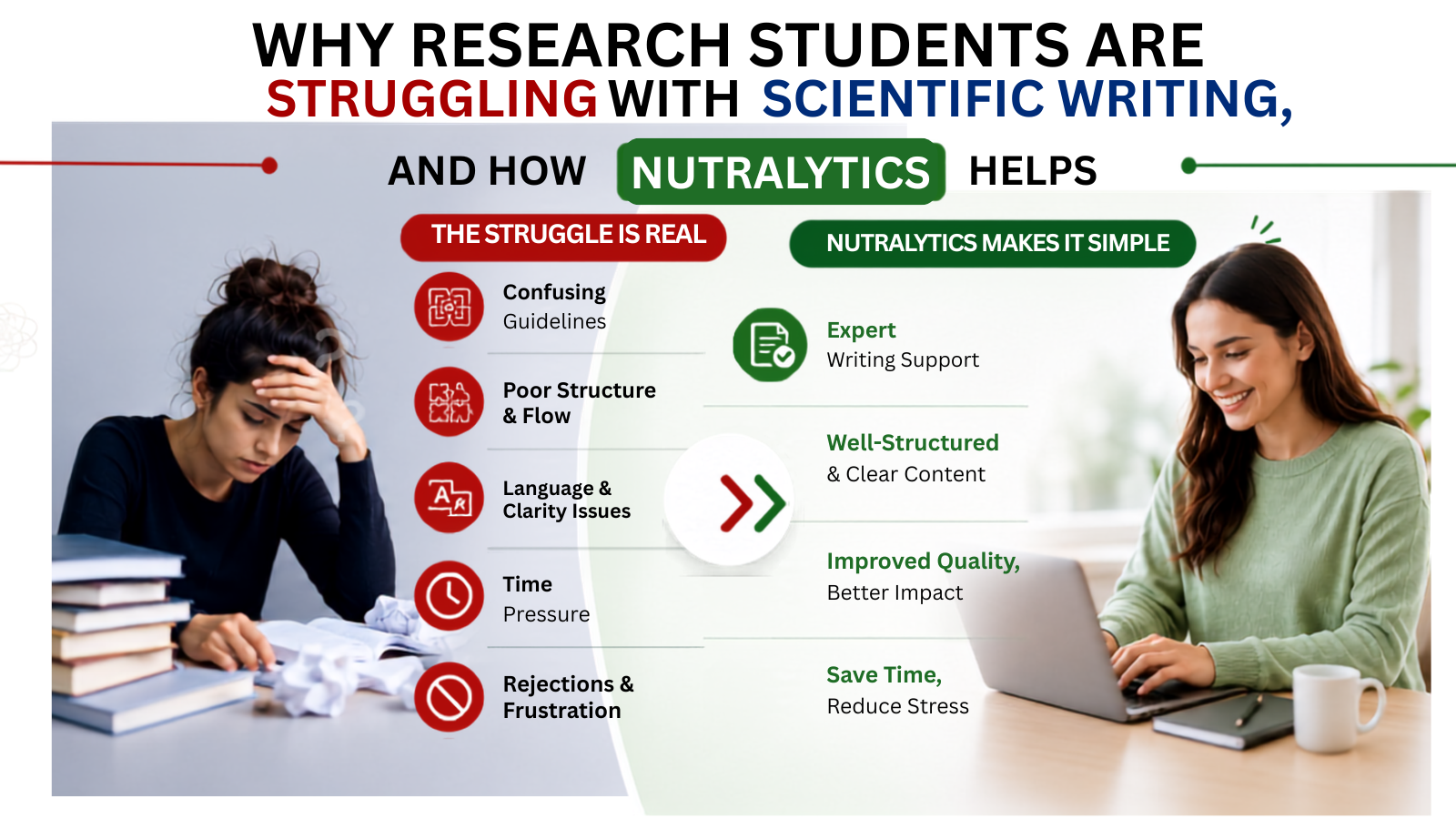
A lot of master’s and PhD students find research and scientific writing confusing. For students and scholars, academic writing is a little stepwise help at Nutralytics. The majority of research students are not poor in intelligence.
And they struggle because nobody shows them how research really works. During master’s and PhD, students are suddenly tasked with selecting a topic, reading papers, detecting gaps, writing objectives and designing methodology, analysing data and publishing research articles.
But most students actually come into this phase not fully trained in scientific thought and in academic writing. It’s a lot of frustration, delay, bewilderment, wasted time.
Where a Student Generally Gets Stuck
For many students, research starts with a very basic question: “What am I supposed to do?” They read papers but lack the means to understand them. They gather data, but don’t know how to share it. They write paragraphs but too much text is either too simple, too copied or too artificial intelligence-generated.
They understand their work has merit, but they cannot turn that into a relevant thesis, a dissertation, a manuscript or a research proposal. This is not a small problem. It changes confidence, timelines, publication prospects and in some cases the entirePhD process
Why is scientific writing different and why is it not?
Writing about science is not the kind of writing you do. It is structured thinking. A good research document must explain clearly:
- What problem is being studied.
- Why the problem is important.
- What research has fallen short (including the gaps in current literature).
- What purpose of the inquiry is the study seeking to achieve.
- How the study was conducted.
- What the results mean.
- Why the findings matter.
In the majority of cases, students are never trained to link these points. In a time when modern scientific writing in general tends to be dry, the way their writing works out is a little too fluff, a little too descriptive and perhaps just a tad confusing. To write well, one needs to have logic, structure, proof of claims, precision and discipline.
How Nutralytics Helps to Help Research Students
At Nutralytics, we know this gap quite well. We provide academic and scientific writing supportprimarily for students who are struggling with their research experience. We guide students with every piece from the fundamentals. Instead of just editing documents, we guide them to understand the research process. Our support includes:
- Topic refinement.
- Literature review guidance.
- Research gap identification.
- Framing of objective and hypothesis.
- Synopsis and proposal writing.
- Structuring of thesis and dissertation.
- Manuscript writing.
- Result interpretation.
- Journal formatting.
- Reviewer response drafting.
- Reducing AI-like content and enhancing academic tone.
One document is not meant to be filled out in one sitting. The goal is to give students the idea of knowing how research is constructed.
The Importance of Step-by-Step Guiding You Up and Down the Road
The smaller the steps, the easier research becomes. First understand the problem. Then read the literature. Then find the gap. Then frame the objective. Then choose the method. Then analyse the result.
Then write the story. Writing gets a big jump when the students can stick to this sequence. A thesis or a manuscript is not written in a day. It is formulated layer by layer. With the right direction, students save time, make fewer common errors, and build confidence in their own work.
The Way Forward
Scientific writing constitutes one of the key skills that every research student needs. Whatever you do — whether you are pursuing M.Pharm, M.Sc, MPH, PhD, clinical research, nutrition, pharmacy, public health, or life sciences — the worth of your research depends entirely on the ways in which it is communicated.
Here at Nutralytics we guide students away from confusion into clarity. We offer a guided academic writing support so that students are able to complete their research work confidently and successfully. Research should not be seen as a chore. It becomes a skill with the right guidance.



Leave a Reply